

The short answer: on a New Mexico project covered by the Public Works Minimum Wage Act, every contractor and subcontractor pays its workers at least once a week. Each one updates a numbered certified payroll every week and attaches a Statement of Compliance. The prime contractor delivers its own payrolls and its subcontractors' payrolls to the contracting agency every month, and to the Department of Workforce Solutions (DWS) Labor Relations Division within 10 business days of a request. Before final payment, the contractor and each subcontractor sign a notarized affidavit of wages paid (11.1.2.9 NMAC).
To find out whether your project is covered, and what an underpayment can cost, start with the New Mexico Public Works Prevailing Wage Guide.
The steps follow the statute and rule text we read on November 10, 2026. DWS changes its forms and rates, so use the forms DWS currently publishes.
Step 1: Confirm the Project Is Covered
Write down the answers and keep them in the project file.
- Public party. Is the state, a county, a city, a school district, or another political subdivision a party to a contract or project over $60,000? If so, section 13-4-11(A) applies.
- Industrial revenue bond. Did a county or municipality issue an industrial revenue bond for the project? Since the 2025 amendment, section 13-4-11(J) requires the prevailing wage on those projects (House Bill 6, Laws 2025, chapter 132).
- Federal credit. Will the owner claim the increased federal credit? Then federal rates apply as well, and you check pay against both.
Step 2: Register with the Labor Relations Division
A contractor must be registered with the division to submit a bid over $60,000, or to be considered for any portion over $60,000, on a project subject to the Act. This applies whether or not the contractor is the prime contractor. A public body cannot accept a bid from a prime contractor that does not show proof of registration (section 13-4-13.1). The current rule requires a valid registration when bids are due and for the duration of the project.
DWS's Public Works Project Requirements sheet says contractors register in the Public Works and Apprenticeship Application (PWAA). It also says the general contractor must make sure each subcontractor bidding over $60,000 has an active registration before it bids. Save each subcontractor's proof of registration with the date you checked it.
Step 3: Get the Wage Decision, Then Match Workers
The contracting agency requests the wage decision from the division at least three weeks before it advertises for bids, and includes the decision in the bid specifications. One decision governs the project for its duration (11.1.2.9 and 11.1.2.14 NMAC). On an industrial revenue bond project, no public agency advertises for bids, and the Act does not say who makes the request. Ask DWS and the issuing county or municipality before construction.
The decision assigns a construction type: A, B, C, or H. Type H, heavy engineering, lists power generating plants. If no single type is 80% or more of the contract cost, each type's rates apply to its own work (11.1.2.10 NMAC). Then:
- Put the wage decision number in every subcontract. Every payroll must show it.
- Assign each worker a classification from the decision before the first payroll. A worker who does two kinds of work is paid, and reported, in each classification for the hours worked in it.
- Record three amounts for each classification: the base rate, the fringe benefit rate, and the apprenticeship contribution.
Step 4: Send the Subcontractor List and Statements of Intent
Within three days of award, the general contractor gives the contracting agency a complete subcontractor list and a Statement of Intent to Pay Prevailing Wages for every contractor, "regardless of amount of work."
DWS's sheet says every subcontractor and tier except professional services must be on the list and must pay prevailing wages, whatever its contract amount. Update the list whenever a subcontractor is added.
Step 5: Post the Rates and Pay Every Week
The contractor posts the wage and fringe benefit rates in a prominent, easily accessible place at the site. DWS says the wage rate poster is provided in PWAA. Each employer pays its mechanics and laborers "not less often than once a week" at no less than the project's wage and fringe benefit rates (section 13-4-11(A) and (C)). A biweekly pay cycle does not meet that requirement.
Each employer also pays its Public Works Apprentice and Training Act contribution, either to an approved apprenticeship program or to the state's Public Works Apprentice and Training Fund.
Step 6: Build the Certified Payroll Each Week
Number the payrolls from one, starting with the first payroll on the job, and keep the sequence unbroken until the job is complete. The rule lists what each payroll must contain:
- the worker's full name (on the first payroll the worker appears on) and classification;
- the hourly wage rate, fringe benefit rate, subsistence and zone pay, and overtime rate;
- the daily and weekly hours worked in each classification, including the actual overtime hours;
- itemized deductions and net wages paid;
- the wage decision number;
- the Statement of Compliance form; and
- a fringe benefit statement and a fringe benefit annualization worksheet, when they apply.
Certify each apprentice's registration on the first payroll the apprentice appears on (11.1.2.19 NMAC). Keep each worker's full Social Security number and current address on file for the director.
Step 7: Certify and Deliver the Payrolls
The Statement of Compliance goes with each payroll. The rule requires the form but does not describe it, and DWS's requirements sheet points contractors to the DWS Public Works page for forms. Take the current form from there.
The prime contractor delivers the payrolls to the contracting agency every month, including copies from every subcontractor. The prime contractor is responsible for the subcontractors' copies, so collect them weekly instead of waiting for the end of the month. If the director requests payroll records, the contractor has 10 business days to provide legible copies. The contract may set a shorter schedule than the rule.
Step 8: Close Out with the Affidavit of Wages Paid
Before final payment, the contractor and each subcontractor sign a notarized affidavit of wages paid, and the general contractor sends the affidavits to the contracting agency. Keep the payroll records for at least three years after final payment (11.1.2.9 NMAC). A payroll held by a contracting agency can be inspected under the Inspection of Public Records Act (section 13-4-11(D)).
Common Mistakes
- Treating "certified weekly payroll" as a weekly filing. The payroll is updated weekly and delivered to the contracting agency monthly, unless the contract says otherwise.
- Paying every two weeks. The Act requires payment at least once a week.
- Assuming a small subcontractor is exempt. The $60,000 figure decides who must register. Every tier pays prevailing wages and appears on the subcontractor list.
- Using a federal rate. A Davis-Bacon wage determination is not the New Mexico wage decision. On a project that owes both, compare each worker's pay with each.
- Leaving out the apprenticeship contribution. The contribution is a third amount on the wage decision, separate from the base rate and the fringe benefit rate.
- Finding a shortfall after a complaint. When an underpayment to one employee is more than $500, the employer is liable for three times the unpaid amount, and for $100 for each day of a willful violation (section 13-4-14). Checking pay against the wage decision every pay period costs less.
Where DSPTCH Fits
Eight steps, repeated every week, for every contractor on the job. That is the real cost of a New Mexico public works project. Our managed compliance team takes it on: we onboard your contractors, get each contractor’s payroll in, review it every pay period, and tell them who was underpaid and by how much. Scope and price are agreed per project.
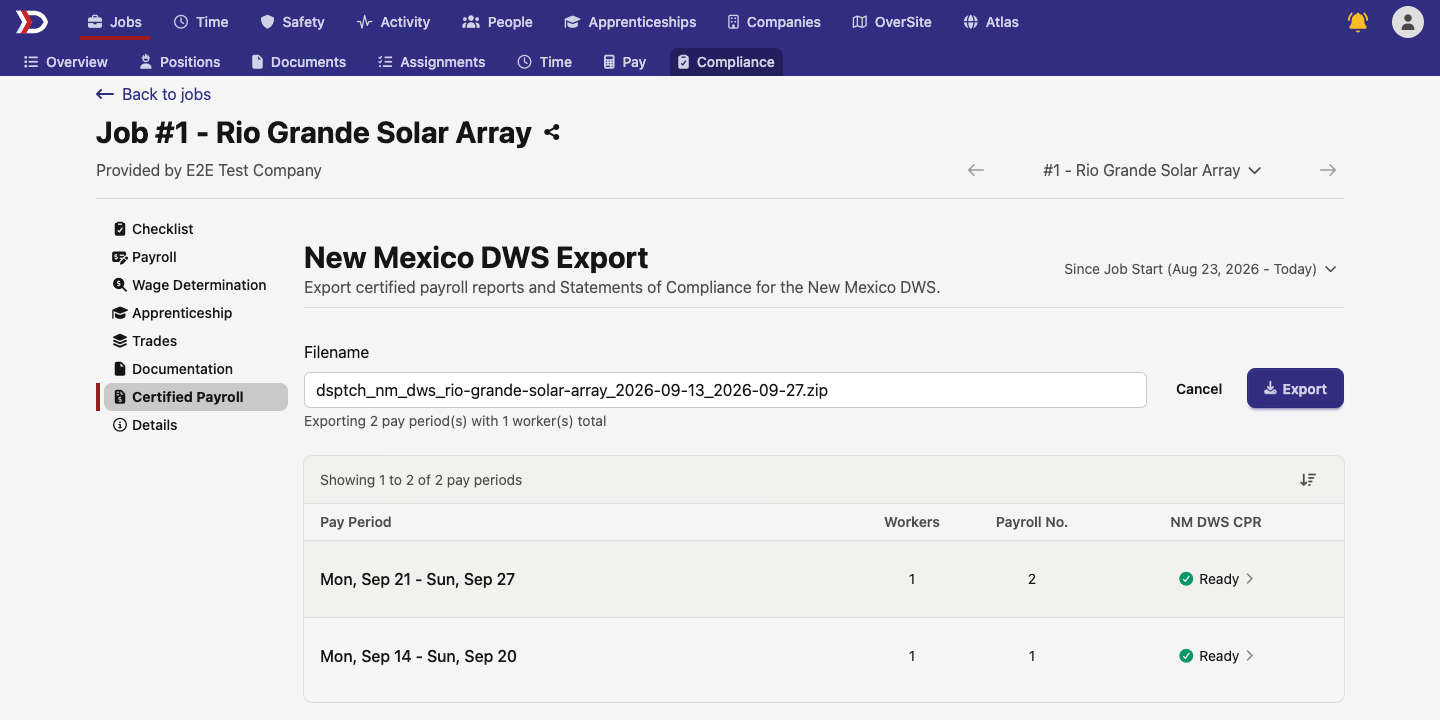
DSPTCH holds the job’s wage rates: the federal Davis-Bacon rates from SAM.gov and the New Mexico rates from the wage decision. Each worker’s pay is compared with them every pay period. From the payroll recorded for the job, DSPTCH prepares New Mexico DWS certified payroll reports and Statements of Compliance as PDFs, for one week or a date range. Every export lists the workers included and the reason any worker is left out.
Hand us the project and the weekly grind is ours. See how we run it
Book a 30-minute introduction or a one-hour detailed session to walk through a New Mexico project's payroll with our team.
Sources
All sources were fetched and reviewed November 10, 2026. Statutes are cited to the Legislature’s enrolled bills.
- 11.1.2 NMAC, Public Works Minimum Wage Act Policy Manual
- House Bill 6, Laws 2025, chapter 132 (PDF): section 13-4-11 NMSA 1978 as amended
- Senate Bill 98, Laws 2020, chapter 47 (PDF): sections 13-4-13 and 13-4-14
- Senate Bill 617, Laws 2011, chapter 94 (PDF): section 13-4-13.1, contractor registration
- DWS Labor Relations Division: Public Works Project Requirements (PDF), copy published by New Mexico Tech
- DWS: Public Works, for current forms and rates